
0%

Choosing the China best premium designer eyeglasses manufacturer requires more than comparing prices or factory photographs. The word “best” is slippery. A reliable evaluation must examine design capability, material quality, production consistency, and communication. Premium designer eyeglasses should combine visual distinction with practical comfort. Their acetate should feel substantial, not brittle. Their hinges should open smoothly. Their lens bevels should remain clean under close inspection.

Alain Mikli, a respected eyewear designer, has said, “Eyewear is not just an accessory; it is part of the face.” This principle explains why manufacturing details matter. A slightly uneven bridge can change the entire expression. A frame that presses behind the ear may fail, even when its colors look beautiful online. Strong Chinese manufacturers often provide advanced acetate cutting, precise CNC shaping, custom metal components, and flexible sampling services. However, capability differs widely between suppliers.

Experience matters here. Request physical samples, production records, material documentation, and clear quality-control procedures. Check whether the factory can maintain alignment across repeated batches. Ask how it manages coating durability, logo placement, hinge testing, and final inspection. Certifications can support credibility, but they should not replace direct evidence. A polished website proves little.

The strongest manufacturer is not always the largest one. It may be the partner that understands your design language, reports problems honestly, and improves after criticism. That is less glamorous. It is also more dependable. This guide explores how to identify that partner and build premium designer eyeglasses with confidence.
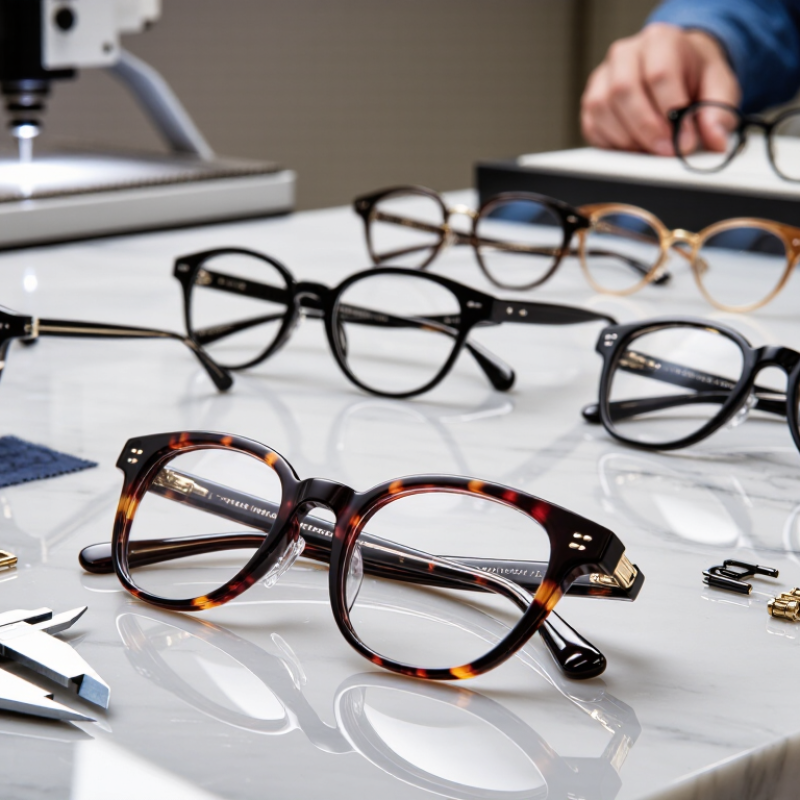
China Best Premium Designer Eyeglasses Manufacturer?

Definition of Premium Designer Eyeglasses

Premium designer eyeglasses are not defined by a high price or decorative packaging. The category is not perfectly fixed. In practice, premium means a deliberate combination of design identity, optical safety, material quality, comfort, and controlled production. A well-made frame should sit evenly on the nose, open smoothly at the hinges, and keep its shape after repeated use. Acetate, titanium, and carefully finished stainless steel can support these qualities when properly processed.

Industry data shows why this definition matters. Fortune Business Insights valued the global eyewear market at approximately 119.83 billion US dollars in 2023. The report expects continued growth through 2032.

Meanwhile, the World Health Organization reports that at least 2.2 billion people live with near or distance vision impairment. Premium eyewear therefore needs more than visual appeal. Lens compatibility, UV performance, dimensional accuracy, and reliable fitting deserve equal attention.

Frame testing can follow EN ISO 12870, while production records should document material batches and inspection results.

For a China-based manufacturer, expertise appears in the details. Laser-etched measurements, controlled polishing, clean edge finishing, and repeated hinge testing show practical experience. Independent laboratory checks add credibility. However, a beautiful sample does not prove stable mass production. Even experienced buyers can miss small alignment defects under showroom lighting. Factory audits, pre-shipment inspections, and transparent quality records remain necessary. Premium designer eyeglasses should feel distinctive, but never at the expense of comfort, safety, or measurable reliability.

Key Features of High-Quality Eyewear Manufacturing

China Best Premium Designer Eyeglasses Manufacturer?

High-quality eyewear manufacturing starts with controlled materials, not attractive packaging. The World Health Organization’s World Report on Vision (2019) estimated that at least 2.2 billion people live with vision impairment. This creates serious responsibility for frame makers. Premium production should use verified acetate, corrosion-resistant metal, and skin-safe coatings. Each batch needs documented supplier records. Small details matter.

A capable Chinese manufacturer should combine skilled hand-finishing with measurable factory controls. ISO 12870 covers requirements for spectacle frames, including dimensional stability, durability, and nickel release. Production teams should inspect hinge alignment, lens grooves, weld points, and surface polishing. Digital calipers can detect uneven temple length before shipment. Random sampling alone is not enough. Traceability is better.

Market pressure is also rising. Fortune Business Insights reported that the global eyewear market was valued at about USD 129.46 billion in 2023. Buyers now expect design flexibility, stable quality, and shorter development cycles. A premium factory should offer prototypes, color samples, and clear inspection reports before mass production. Yet no process is perfect. Hand polishing can still create slight variation. That weakness deserves honest review, not hidden retouching. Reliable manufacturing means testing repeatedly, recording failures, and improving the next production run.

Materials and Technologies Used in Designer Eyeglasses

China Best Premium Designer Eyeglasses Manufacturer?

Premium designer eyeglasses depend on material selection, precise engineering, and consistent quality control. High-grade acetate offers rich color depth, comfortable skin contact, and strong shaping performance. Skilled technicians heat and polish each frame to reduce sharp edges and visible stress marks. Titanium provides a lightweight structure, excellent corrosion resistance, and reliable flexibility. Stainless steel can support slim temples and detailed bridge designs. However, every material has limits. Acetate may change slightly with heat, while titanium requires specialized welding and finishing equipment.

Modern production combines manual experience with digital technology. Computer-aided design helps engineers test proportions before cutting begins. CNC machining creates accurate hinge seats, lens rims, and temple grooves. Laser welding can produce clean connections on metal frames. Experienced inspectors still check alignment by hand. They examine hinge movement, surface polish, lens fitting, and temple balance. Automated tools improve repeatability, but they cannot replace every human judgment. Small flaws may appear under strong lighting, so inspection standards should remain practical and transparent.

Tips: Ask about acetate thickness, titanium grade, hinge construction, and surface testing. Request sample measurements before mass production. Check whether frames return smoothly after repeated opening. Do not judge quality by appearance alone. A beautiful frame can still feel uncomfortable. Allow wear testing, because laboratory results do not reveal everything.

Materials and Technologies Used in Designer Eyeglasses

Frame material density influences weight, durability, and manufacturing choices. Cellulose acetate and TR-90 are lightweight options commonly shaped by precision cutting, polishing, and injection molding, while titanium and stainless steel support thin, strong designs through CNC machining, bending, and laser welding.

How to Evaluate a Chinese Eyeglasses Manufacturer

China Best Premium Designer Eyeglasses Manufacturer?

How to Evaluate a Chinese Eyeglasses Manufacturer

Choosing a Chinese eyeglasses manufacturer requires more than reviewing attractive catalog images. The World Health Organization reports that at least 2.2 billion people worldwide have vision impairment. This demand makes production reliability essential. Request factory details, monthly capacity, equipment lists, and export experience. Visit the facility when possible. Observe lens inspection, frame polishing, assembly, and packing. Small details matter.

Check whether the manufacturer follows ISO 12870 for spectacle frames and uses documented quality procedures. An ISO 9001 certificate supports process control, but it does not guarantee premium workmanship. Ask for material certificates, coating test results, and batch traceability.

Independent testing can verify nickel release, durability, and optical safety. The International Organization for Standardization provides relevant technical standards, while the World Health Organization offers useful context on global vision needs.

Review samples from different production batches, not one carefully selected piece. Compare hinge alignment, temple flexibility, surface finish, logo accuracy, and packaging protection. Ask how defects are recorded and corrected. Clear answers are encouraging. Vague answers are not. One weakness in many evaluations is overvaluing communication speed. Fast replies cannot replace stable production data. A polished sample may also hide inconsistent workmanship. Use a written specification, pre-production approval, and random final inspection. No audit is perfect. Good judgment still requires questioning your own assumptions.

Customization, Quality Control, and Global Supply Capabilities

China Best Premium Designer Eyeglasses Manufacturer?

Premium eyewear manufacturing starts with measurable customization, not a catalog promise. Buyers can specify acetate thickness, bridge geometry, hinge resistance, lens positioning, and surface texture. A skilled factory should convert these choices into CAD files, approved samples, and repeatable tolerances. The World Health Organization’s 2019 World Report on Vision estimates that at least 2.2 billion people have near or distance vision impairment. Fit, clarity, and comfort therefore matter beyond appearance.

Quality control needs evidence at every checkpoint. Incoming acetate should be checked for color variation and internal stress. Frame dimensions require calibrated gauges. Finished pieces need hinge-cycle, lens-fit, coating, and drop inspections. ISO 9001:2015 offers a useful quality-management framework, but certification alone proves little about daily discipline. In my experience, photo records, batch codes, retained samples, and corrective-action logs reveal more. Small faults still escape. That is the uncomfortable part.

Global supply capability means more than shipping cartons. A reliable manufacturer should provide realistic lead times, multilingual specifications, packaging tests, and traceable export documents. International Trade Centre Trade Map data shows how widely optical goods move across markets, making consistency essential. Grand View Research’s eyewear market analysis projects continued growth through 2030, but growth can expose weak planning. Dual-source components, safety stock, and transparent updates reduce disruption. They do not eliminate it. A serious supplier admits that limitation and measures improvement.

China Best Premium Designer Eyeglasses Manufacturer? - Customization, Quality Control, and Global Supply Capabilities
Evaluation Area Key Metric Practical Benchmark Recommended Verification Buyer Relevance
Customization Prototype development time Approximately 7–15 working days after technical drawings and specifications are approved Request a dated development schedule covering 3D design, tooling, samples, revisions, and final approval Helps shorten collection launch cycles and reduces uncertainty before bulk production
Customization Frame material options Acetate, stainless steel, titanium, TR-based materials, and injection-molded polymers Check material certificates, composition declarations, and sample cross-sections where applicable Supports different price tiers, weight targets, durability requirements, and design concepts
Customization Standard frame size range Common adult eye sizes of approximately 45–60 mm, bridge sizes of 15–24 mm, and temple lengths of 125–150 mm Approve a technical size chart showing eye, bridge, temple, effective diameter, and pantoscopic angle requirements Improves fit consistency across markets and supports accurate product listings
Customization Color and finish development Solid, transparent, laminated, metallic, brushed, polished, matte, and custom color-matching options Use physical color chips or approved master samples rather than relying only on digital images Reduces shade variation and protects the intended appearance of premium collections
Customization Branding and packaging integration Temple markings, laser engraving, pad printing, cases, cleaning cloths, labels, and retail packaging Review artwork files, placement tolerances, print durability, packaging specifications, and barcode requirements Provides a consistent unboxing experience without relying on third-party assembly
Quality Control Incoming material inspection Inspection of color, dimensions, surface condition, material identity, and supplier documentation before production use Ask for inspection checklists, lot records, and nonconformance handling procedures Prevents defective or inconsistent materials from entering the production process
Quality Control Dimensional tolerance management Critical dimensions should be defined on approved technical drawings; typical noncritical tolerances are often around ±0.20–0.50 mm, subject to design Confirm tolerances for eye size, bridge, temple length, hinge position, lens groove, and logo placement Improves interchangeability, wearer comfort, lens fitting, and production repeatability
Quality Control Hinge and temple durability Repeated opening and closing tests should be defined by the product specification; test cycles commonly range from 5,000 to 20,000 Request the test method, load conditions, cycle count, acceptance criteria, and test records Reduces failures caused by loose hinges, misalignment, or premature temple fatigue
Quality Control Surface and coating inspection Inspection for scratches, pits, bubbles, uneven polish, color deviation, plating defects, and coating adhesion Define an approved sample, viewing distance, lighting conditions, defect limits, and inspection grade Protects the visual quality expected from premium designer-style eyewear
Quality Control Sampling and final inspection AQL-based or risk-based sampling, with 100% visual inspection for critical appearance and assembly points Agree on sample size, critical/major/minor defect definitions, and shipment release requirements before production Creates an objective basis for accepting or rejecting finished goods
Quality Control Eyewear standards alignment Frame products may be evaluated against ISO 12870; sunglasses may be evaluated against ISO 12312-1, depending on product category and destination Confirm the applicable standard, test laboratory, test scope, and destination-market requirements Supports regulatory documentation and reduces compliance risks in international sales
Supply Capability Minimum order quantity Custom production commonly starts at several hundred pieces per color or style, while stock programs may allow lower quantities Request separate quotations for stock, modified, and fully custom designs, including tooling and packaging charges Allows buyers to balance exclusivity, unit cost, inventory exposure, and market testing
Supply Capability Bulk production lead time Approximately 30–60 calendar days after sample approval, deposit confirmation, and material availability Obtain a production milestone plan covering material ordering, assembly, inspection, packing, and dispatch Supports launch planning, seasonal purchasing, and replenishment decisions
Supply Capability Production capacity planning Capacity should be stated by style, color, and monthly output rather than only as a total factory figure Request capacity allocation, line loading, overtime policy, and contingency plans for peak periods Helps confirm whether the supplier can maintain quality during larger or repeat orders
Supply Capability Export packaging configuration Individual protective packaging, inner cartons, master cartons, moisture protection where required, and shipping marks Approve carton dimensions, gross weight, carton quantity, drop-test expectations, and palletization requirements Reduces transit damage and improves warehouse receiving efficiency
Supply Capability International logistics support Air freight, sea freight, courier, and multimodal shipping options with export documentation support Compare Incoterms, transit estimates, cargo insurance, customs documents, and destination delivery responsibilities Improves landed-cost accuracy and reduces delays at international borders
Compliance Chemical and material compliance Documentation may include restricted-substance declarations, material safety information, and destination-specific compliance records Specify applicable requirements such as REACH or other local chemical regulations according to the target market Helps prevent customs, marketplace, and retailer compliance issues
Supplier Management Traceability and corrective action Each production lot should be linked to materials, inspection records, operators or lines, and shipment documentation Check whether the supplier uses lot numbers, defect reports, root-cause analysis, and corrective-action deadlines Enables faster investigation and resolution when quality issues appear after delivery

FAQS

What makes premium designer eyeglasses different from ordinary frames?

Premium quality combines distinctive design, optical safety, strong materials, comfort, and controlled production. Price alone proves little.

Which materials are commonly used for high-quality frames?

Acetate offers rich colors and comfortable skin contact. Titanium is lightweight and corrosion-resistant. Stainless steel supports slim structures.

What should a comfortable frame feel like?

It should sit evenly on the nose and remain balanced behind the ears. The temples should not create pressure points.Small details matter.

How can manufacturers control frame accuracy?

Computer-aided design, CNC machining, digital calipers, and repeated hinge testing improve consistency. Inspectors should still check alignment by hand.

What quality checks should buyers request?

Request material records, sample measurements, hinge tests, surface inspections, and lens-fitting results. Pre-shipment inspection is also useful.

Why is material traceability important?

Batch records can identify material sources and production problems. They also support more consistent results across different orders.

Can a beautiful sample prove reliable mass production?

No. A showroom sample may hide small alignment defects. Stable production requires audits, repeated testing, and documented inspections.

What weaknesses should buyers consider before ordering?

Hand polishing may create slight variation. Acetate can shift with heat, while titanium needs specialized welding. No process is perfect.

How should frames be tested during development?

Open and close the hinges repeatedly. Check lens grooves, temple balance, surface edges, and shape recovery after wear.Laboratory results are not everything.

What questions should buyers ask a manufacturer?

Ask about material grades, acetate thickness, hinge construction, surface testing, prototype approval, and inspection records. Also request real sample measurements.A good question can expose a weak process.

Conclusion

Choosing the right China-based manufacturer for premium designer eyeglasses requires more than comparing prices. Premium eyewear combines refined design, lasting comfort, precise optical performance, and consistent craftsmanship. High-quality manufacturers typically use materials such as acetate, stainless steel, titanium, and advanced lens components, supported by modern molding, CNC machining, polishing, coating, and assembly technologies. These capabilities help create frames that are lightweight, durable, stylish, and suitable for different market preferences.

When evaluating a manufacturer, buyers should examine production experience, material sourcing, technical expertise, quality control procedures, and communication efficiency. A reliable partner should offer flexible customization, including frame shapes, colors, dimensions, packaging, and project-specific specifications. Thorough inspections at every production stage, from incoming materials to final assembly, can reduce defects and ensure consistency. Strong global supply capabilities, stable lead times, secure packaging, and professional documentation are also essential. By assessing these factors carefully, businesses can identify a dependable manufacturer capable of delivering premium designer eyeglasses that meet high quality and market expectations.

Evelyn

Evelyn

Evelyn is a highly experienced marketing professional dedicated to helping businesses understand products, markets, and customer needs more clearly. With a strong background in strategic communication, content development, and product education, she brings both creativity and analytical insight to......