
Precision Portfolio
Engineered Prescription Collections Ready for Export
Precision-milled titanium, cellulose acetate block carving, and selective laser sintering (SLS) prototyping manufactured in ISO 9001 and ISO 13485 audited optical manufacturing cleanrooms.

145+
Years Optical Lineage (Since 1879)
2.8M
Annual Prescription Frames Exported
< 0.28%
Dispensing Table Return Rate
72+
Destination Export Countries
Prescription Eyewear Manufacturing: Engineering Standards & B2B Procurement Parameters
The global ophthalmic framework has undergone a decisive structural transformation. Sourcing departments no longer evaluate prospective vendors purely on free-on-board (FOB) price tags. Today, commercial success hinges upon micron-level dimensional stability, metallurgical compliance, and chemical resilience of ocular surfaces. When sourcing bulk prescription glasses, an optical retailer or hospital chain assumes immense legal and reputational liability. The lens-groove bevel tolerance, temple spring flex life cycles, and pantoscopic tilt retention directly dictate patient ocular comfort and brand equity.
In accordance with ISO 12870:2016 (Ophthalmic Optics — Spectacle Frames) and ANSI Z80.5 standards, industrial exporters must satisfy comprehensive structural validation criteria. High-throughput prescription glazing requires frames to withstand localized stress concentrations of up to 45 Newtons during hydraulic cold-snap and heat-induction lens insertion without fracture or micro-crazing. Cheaper alternatives manufactured from low-purity recycled polycarbonate or inferior zinc-aluminum alloys suffer cold embrittlement and rapid creep deformation, translating directly into high return rates at the clinic level.
Metallurgical Chemistry
Adherence to Medical Grade Japanese Beta-Titanium (Ti-15V-3Cr-3Sn-3Al) and high-density pure titanium (Grade 2/4) guarantees biocompatibility, absolute nickel-free dermal contact, and non-corrosive longevity under high sweat exposure.
Additive Powder Infusion
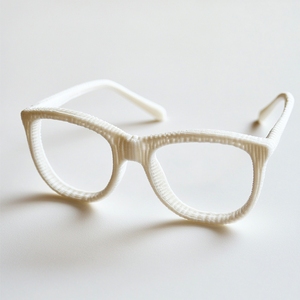
Industrial SLS (Selective Laser Sintering) utilizing medical polyamide PA11 and PA12 allows hollow geometry, extreme mass reduction down to 4.2 grams per frame, and zero-inventory-waste agile prototyping.
Surface Passivation
Physical Vapor Deposition (PVD) titanium nitriding and automated 72-hour barrel tumbling deliver micro-hardness exceeding 2500 HV, resisting cosmetic chipping and micro-delamination throughout 24+ months of continuous usage.
Future Procurement Trends: 2025–2030 Optical Supply Chain Evolution
The global ophthalmic distribution ecosystem is navigating two convergent macro trends: the aggressive demand for circular eco-responsible feedstocks and the integration of smart, digital-ready ocular platforms. Procurement directors are recalibrating their long-term supply relationships around predictable ESG matrices, agile low-MOQ rapid replenishment, and additive custom manufacturing protocols.
1. Bio-Based and Circular Cellulose Acetates: Traditional fossil-derived plasticizers like diethyl phthalate (DEP) are being aggressively phased out in favor of bio-based triethyl citrate plasticizers derived from corn starch and wood pulp residues. Leading exporters offer optical-grade bio-acetate boasting biodegradability exceeding 65% within 180 days under ISO 14855 composting conditions, completely free of volatile organic phthalates.
2. Additive SLS Direct-to-Consumer Customization: In-practice 3D scanning allows facial parametric modeling to dictate frame temple lengths, pantoscopic angle, and bridge spread. Exporters equipped with industrial SLS SLS/MJF printing lines furnish independent opticians with bespoke custom sizing, entirely mitigating excess unsellable stock and obsolescence risk.
3. Carbon Fiber & Multi-Material Hybridization: By coupling continuous-weave carbon fiber with Japanese beta-titanium core wires and acetate rims (as seen in our luxury Feroce collection), frames gain tensile rigidity up to 3500 MPa while allowing opticians simple thermal adjusting capability via conventional warm air frame heaters.
Procurement & Manufacturing FAQ: Optical Supply Chain
What are the standard Minimum Order Quantities (MOQ) for custom OEM/ODM prescription frames?
Our standard production runs vary based on metallurgical and manufacturing processes:
- CNC Acetate Collections: Standard MOQ is 300 pieces per model, split across 3 custom colorways (100 pcs/color).
- Pure Titanium & Beta-Titanium: 300 pieces per tooling setup due to vacuum chamber annealing and mold parameters.
- Additive 3D Printed Polyamide (SLS): Ultra-flexible zero-tooling batching beginning as low as 50 pieces, ideal for niche luxury test batches.
- Ready-to-Ship Wholesale Inventory: Minimum order of 25 assorted pieces from active catalogs for verified optical accounts.
How does your engineering team ensure lens-retention precision across high-diopter prescriptions?
Lens pop-out under torsional stress is a frequent flaw of generic frames. Our ophthalmic frames feature computer-calculated eyewire dimensions with internal V-bevel angles calibrated strictly to 110° ± 1.5° with a depth tolerance of 0.55mm. This ensures absolute stability for high-index (1.67, 1.74) single-vision and progressive digital free-form lenses, preventing frame bowing or unexpected focal-center distortion after glazing.
What surface plating technologies are utilized to prevent sweat-induced corrosion and skin allergy?
All metal frameworks undergo physical vapor deposition (PVD) ion plating in high-vacuum environments, followed by cathodic electrophoretic coating. Every export batch is subjected to a 48-hour continuous artificial sweat immersion test (ISO 12870 clause 4.8) and 24-hour salt spray chambers (ASTM B117), guaranteeing 100% hypoallergenic reliability and zero peeling even in humid, tropical markets.
Can you manage proprietary branding, custom temple printing, and bespoke optical cases?
Yes. We offer turnkey white-label and private-label customization programs. Capabilities include high-definition fiber laser engraving on titanium temples, hot-foil core-wire embossing, diamond micro-milling on end-tips, RFID anti-theft smart-tag integration, and sustainable recycled RPET folding hard cases engineered to match retail branding specifications.
What lead times are associated with sample prototyping versus mass optical manufacturing?
Prototyping workflows: Initial 2D mechanical rendering and 3D CAD files are finalized within 72 hours. Additive SLS functional resin/nylon samples are delivered within 7 to 10 working days. Pre-production handmade metal/acetate samples require 20 to 25 days. Full-scale production cycles typically range between 45 to 60 days following sample sign-off, supported by real-time milestone tracking through our export desk.
Partner with a Globally Verified Optical Manufacturer
Elevate your dispensing board with engineered frames that minimize clinic returns, maximize patient satisfaction, and deliver dependable margins. Request our comprehensive commercial lookbook and export pricing today.
Get Catalog